

Atlantic Coastal Biome
225
0
20
40
60
80
100
0
2
4
6
8
10
Climatology (years)
Depth (m)
Production at DCM (%)
Zm (sigma)
Zeu
Pt (at DCM)
0.00
0.35
0.70
1.05
1.40
1.75
0.50
1.00
1.50
2.00
2.50
3.00
SeaWiFS (NECS): September 1997 - January 2002
Surface Chl (mg m -3
)
Pt d
-1
Chl m
-3
Pt (gC m
-2
d
-1
)
1998
1999
2000
2001
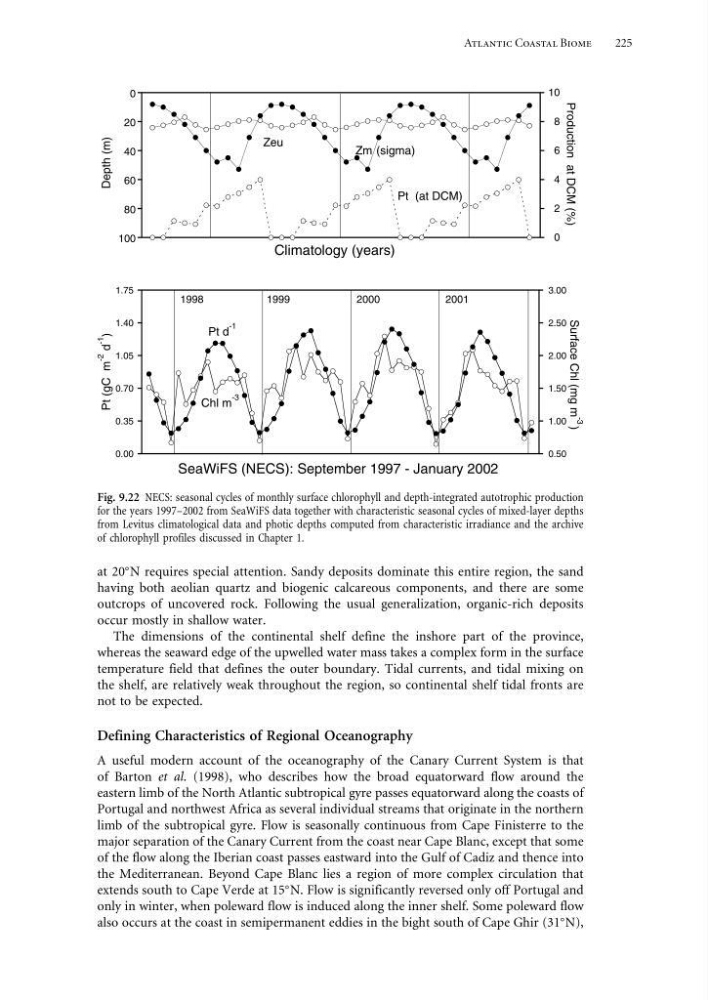
Fig. 9.22 NECS: seasonal cycles of monthly surface chlorophyll and depth-integrated autotrophic production
for the years 1997–2002 from SeaWiFS data together with characteristic seasonal cycles of mixed-layer depths
from Levitus climatological data and photic depths computed from characteristic irradiance and the archive
of chlorophyll profiles discussed in Chapter 1.
at 20
N requires special attention. Sandy deposits dominate this entire region, the sand
having both aeolian quartz and biogenic calcareous components, and there are some
outcrops of uncovered rock. Following the usual generalization, organic-rich deposits
occur mostly in shallow water.
The dimensions of the continental shelf define the inshore part of the province,
whereas the seaward edge of the upwelled water mass takes a complex form in the surface
temperature field that defines the outer boundary. Tidal currents, and tidal mixing on
the shelf, are relatively weak throughout the region, so continental shelf tidal fronts are
not to be expected.
Defining Characteristics of Regional Oceanography
A useful modern account of the oceanography of the Canary Current System is that
of Barton et al. (1998), who describes how the broad equatorward flow around the
eastern limb of the North Atlantic subtropical gyre passes equatorward along the coasts of
Portugal and northwest Africa as several individual streams that originate in the northern
limb of the subtropical gyre. Flow is seasonally continuous from Cape Finisterre to the
major separation of the Canary Current from the coast near Cape Blanc, except that some
of the flow along the Iberian coast passes eastward into the Gulf of Cadiz and thence into
the Mediterranean. Beyond Cape Blanc lies a region of more complex circulation that
extends south to Cape Verde at 15
N. Flow is significantly reversed only off Portugal and
only in winter, when poleward flow is induced along the inner shelf. Some poleward flow
also occurs at the coast in semipermanent eddies in the bight south of Cape Ghir (31
N),
225
0
20
40
60
80
100
0
2
4
6
8
10
Climatology (years)
Depth (m)
Production at DCM (%)
Zm (sigma)
Zeu
Pt (at DCM)
0.00
0.35
0.70
1.05
1.40
1.75
0.50
1.00
1.50
2.00
2.50
3.00
SeaWiFS (NECS): September 1997 - January 2002
Surface Chl (mg m -3
)
Pt d
-1
Chl m
-3
Pt (gC m
-2
d
-1
)
1998
1999
2000
2001
Fig. 9.22 NECS: seasonal cycles of monthly surface chlorophyll and depth-integrated autotrophic production
for the years 1997–2002 from SeaWiFS data together with characteristic seasonal cycles of mixed-layer depths
from Levitus climatological data and photic depths computed from characteristic irradiance and the archive
of chlorophyll profiles discussed in Chapter 1.
at 20
N requires special attention. Sandy deposits dominate this entire region, the sand
having both aeolian quartz and biogenic calcareous components, and there are some
outcrops of uncovered rock. Following the usual generalization, organic-rich deposits
occur mostly in shallow water.
The dimensions of the continental shelf define the inshore part of the province,
whereas the seaward edge of the upwelled water mass takes a complex form in the surface
temperature field that defines the outer boundary. Tidal currents, and tidal mixing on
the shelf, are relatively weak throughout the region, so continental shelf tidal fronts are
not to be expected.
Defining Characteristics of Regional Oceanography
A useful modern account of the oceanography of the Canary Current System is that
of Barton et al. (1998), who describes how the broad equatorward flow around the
eastern limb of the North Atlantic subtropical gyre passes equatorward along the coasts of
Portugal and northwest Africa as several individual streams that originate in the northern
limb of the subtropical gyre. Flow is seasonally continuous from Cape Finisterre to the
major separation of the Canary Current from the coast near Cape Blanc, except that some
of the flow along the Iberian coast passes eastward into the Gulf of Cadiz and thence into
the Mediterranean. Beyond Cape Blanc lies a region of more complex circulation that
extends south to Cape Verde at 15
N. Flow is significantly reversed only off Portugal and
only in winter, when poleward flow is induced along the inner shelf. Some poleward flow
also occurs at the coast in semipermanent eddies in the bight south of Cape Ghir (31
N),