

Atlantic Trade Wind Biome
213
out, the DCM is neither a biomass nor a productivity maximum, as is often assumed, but
rather results from a local increase in the chl/C ratio and represents only a small contribution
to total integrated primary production in the water column. Marañon et al. found that the
phytoplankton turnover rate in the oligotrophic SATL gyre (at 50 mg C m
−2 d
−1 ), measured
as the microalgal growth rate, was unexpectedly low (021 d
−1 at the surface) representing
<20% of maximal expected growth. They suggest that this finding argues against the general assumption of high turnover rates in oligotrophic gyral situations. They did, however,
observe an unexpectedly high variability in phytoplankton dynamics in the oligotrophic
gyre so that productivity and growth rates varied by a factor of 8, while microbial biomass
remained relatively constant. This is consistent with the suggestion of Mahaffey et al. (2004),
also associated with AMT data, that nitrogen supply in oligotrophic gyres is predominantly
from the subthermocline source, probably mostly due to fine-scale upwelling in mesoscale
eddies and frontal systems. General diapycnal transfer and convection, they suggest, is a
minor source in such locations.
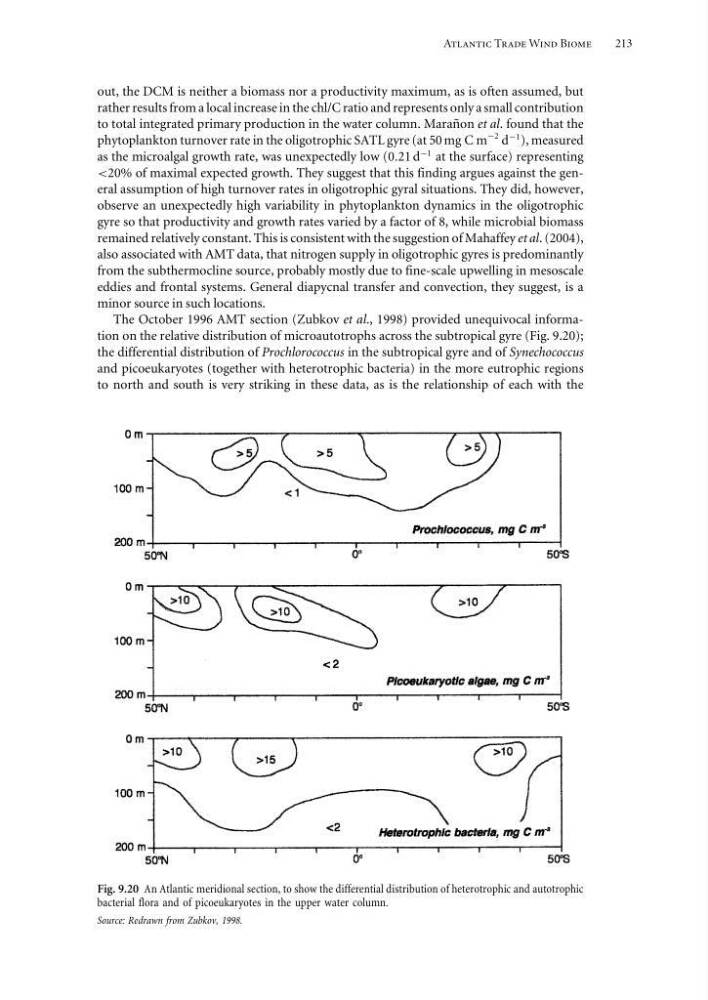
The October 1996 AMT section (Zubkov et al., 1998) provided unequivocal information on the relative distribution of microautotrophs across the subtropical gyre (Fig. 9.20);
the differential distribution of Prochlorococcus in the subtropical gyre and of Synechococcus
and picoeukaryotes (together with heterotrophic bacteria) in the more eutrophic regions
to north and south is very striking in these data, as is the relationship of each with the
Fig. 9.20 An Atlantic meridional section, to show the differential distribution of heterotrophic and autotrophic
bacterial flora and of picoeukaryotes in the upper water column.
Source: Redrawn from Zubkov, 1998.
213
out, the DCM is neither a biomass nor a productivity maximum, as is often assumed, but
rather results from a local increase in the chl/C ratio and represents only a small contribution
to total integrated primary production in the water column. Marañon et al. found that the
phytoplankton turnover rate in the oligotrophic SATL gyre (at 50 mg C m
−2 d
−1 ), measured
as the microalgal growth rate, was unexpectedly low (021 d
−1 at the surface) representing
<20% of maximal expected growth. They suggest that this finding argues against the general assumption of high turnover rates in oligotrophic gyral situations. They did, however,
observe an unexpectedly high variability in phytoplankton dynamics in the oligotrophic
gyre so that productivity and growth rates varied by a factor of 8, while microbial biomass
remained relatively constant. This is consistent with the suggestion of Mahaffey et al. (2004),
also associated with AMT data, that nitrogen supply in oligotrophic gyres is predominantly
from the subthermocline source, probably mostly due to fine-scale upwelling in mesoscale
eddies and frontal systems. General diapycnal transfer and convection, they suggest, is a
minor source in such locations.
The October 1996 AMT section (Zubkov et al., 1998) provided unequivocal information on the relative distribution of microautotrophs across the subtropical gyre (Fig. 9.20);
the differential distribution of Prochlorococcus in the subtropical gyre and of Synechococcus
and picoeukaryotes (together with heterotrophic bacteria) in the more eutrophic regions
to north and south is very striking in these data, as is the relationship of each with the
Fig. 9.20 An Atlantic meridional section, to show the differential distribution of heterotrophic and autotrophic
bacterial flora and of picoeukaryotes in the upper water column.
Source: Redrawn from Zubkov, 1998.