

194
Chapter 9: The Atlantic Ocean
0.00
0.40
0.80
1.20
1.60
2.00
0.00
0.80
1.60
2.40
3.20
4.00
SeaWiFS (CARB): September 1997 - January 2002
Surface Chl (mg m -3
)
Pt d
-1
Chl m
-3
1998
1999
2000
2001
Pt (gC m
-2
d
-1
)
0
20
40
60
80
100
0
5
10
15
20
Climatology (years)
Depth (m)
Production at DCM (%)
Zm (sigma)
Zeu
Pt (at DCM)
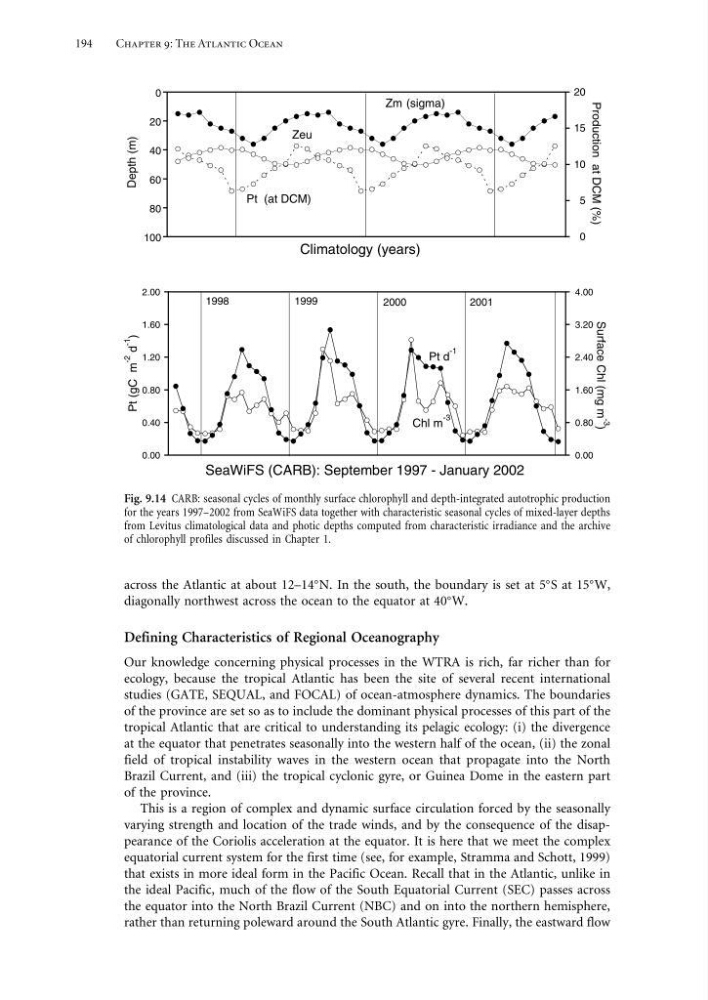
Fig. 9.14 CARB: seasonal cycles of monthly surface chlorophyll and depth-integrated autotrophic production
for the years 1997–2002 from SeaWiFS data together with characteristic seasonal cycles of mixed-layer depths
from Levitus climatological data and photic depths computed from characteristic irradiance and the archive
of chlorophyll profiles discussed in Chapter 1.
across the Atlantic at about 12–14
N. In the south, the boundary is set at 5
S at 15
W,
diagonally northwest across the ocean to the equator at 40
W.
Defining Characteristics of Regional Oceanography
Our knowledge concerning physical processes in the WTRA is rich, far richer than for
ecology, because the tropical Atlantic has been the site of several recent international
studies (GATE, SEQUAL, and FOCAL) of ocean-atmosphere dynamics. The boundaries
of the province are set so as to include the dominant physical processes of this part of the
tropical Atlantic that are critical to understanding its pelagic ecology: (i) the divergence
at the equator that penetrates seasonally into the western half of the ocean, (ii) the zonal
field of tropical instability waves in the western ocean that propagate into the North
Brazil Current, and (iii) the tropical cyclonic gyre, or Guinea Dome in the eastern part
of the province.
This is a region of complex and dynamic surface circulation forced by the seasonally
varying strength and location of the trade winds, and by the consequence of the disappearance of the Coriolis acceleration at the equator. It is here that we meet the complex
equatorial current system for the first time (see, for example, Stramma and Schott, 1999)
that exists in more ideal form in the Pacific Ocean. Recall that in the Atlantic, unlike in
the ideal Pacific, much of the flow of the South Equatorial Current (SEC) passes across
the equator into the North Brazil Current (NBC) and on into the northern hemisphere,
rather than returning poleward around the South Atlantic gyre. Finally, the eastward flow
Chapter 9: The Atlantic Ocean
0.00
0.40
0.80
1.20
1.60
2.00
0.00
0.80
1.60
2.40
3.20
4.00
SeaWiFS (CARB): September 1997 - January 2002
Surface Chl (mg m -3
)
Pt d
-1
Chl m
-3
1998
1999
2000
2001
Pt (gC m
-2
d
-1
)
0
20
40
60
80
100
0
5
10
15
20
Climatology (years)
Depth (m)
Production at DCM (%)
Zm (sigma)
Zeu
Pt (at DCM)
Fig. 9.14 CARB: seasonal cycles of monthly surface chlorophyll and depth-integrated autotrophic production
for the years 1997–2002 from SeaWiFS data together with characteristic seasonal cycles of mixed-layer depths
from Levitus climatological data and photic depths computed from characteristic irradiance and the archive
of chlorophyll profiles discussed in Chapter 1.
across the Atlantic at about 12–14
N. In the south, the boundary is set at 5
S at 15
W,
diagonally northwest across the ocean to the equator at 40
W.
Defining Characteristics of Regional Oceanography
Our knowledge concerning physical processes in the WTRA is rich, far richer than for
ecology, because the tropical Atlantic has been the site of several recent international
studies (GATE, SEQUAL, and FOCAL) of ocean-atmosphere dynamics. The boundaries
of the province are set so as to include the dominant physical processes of this part of the
tropical Atlantic that are critical to understanding its pelagic ecology: (i) the divergence
at the equator that penetrates seasonally into the western half of the ocean, (ii) the zonal
field of tropical instability waves in the western ocean that propagate into the North
Brazil Current, and (iii) the tropical cyclonic gyre, or Guinea Dome in the eastern part
of the province.
This is a region of complex and dynamic surface circulation forced by the seasonally
varying strength and location of the trade winds, and by the consequence of the disappearance of the Coriolis acceleration at the equator. It is here that we meet the complex
equatorial current system for the first time (see, for example, Stramma and Schott, 1999)
that exists in more ideal form in the Pacific Ocean. Recall that in the Atlantic, unlike in
the ideal Pacific, much of the flow of the South Equatorial Current (SEC) passes across
the equator into the North Brazil Current (NBC) and on into the northern hemisphere,
rather than returning poleward around the South Atlantic gyre. Finally, the eastward flow