

Atlantic Trade Wind Biome
183
0
20
40
60
80
100
120
140
0
5
10
15
20
25
30
Climatology (years)
Depth (m)
Production at DCM (%)
Zm (sigma)
Zeu
Pt (at DCM)
0.00
0.25
0.50
0.75
1.00
1.25
0.10
0.20
0.30
0.40
0.50
0.60
SeaWiFS (MEDI): September 1997 - January 2002
Surface Chl (mg m -3
)
Pt (gC m
-2
d
-1
)
Pt d
-1
Chl m
-3
1998
1999
2000
2001
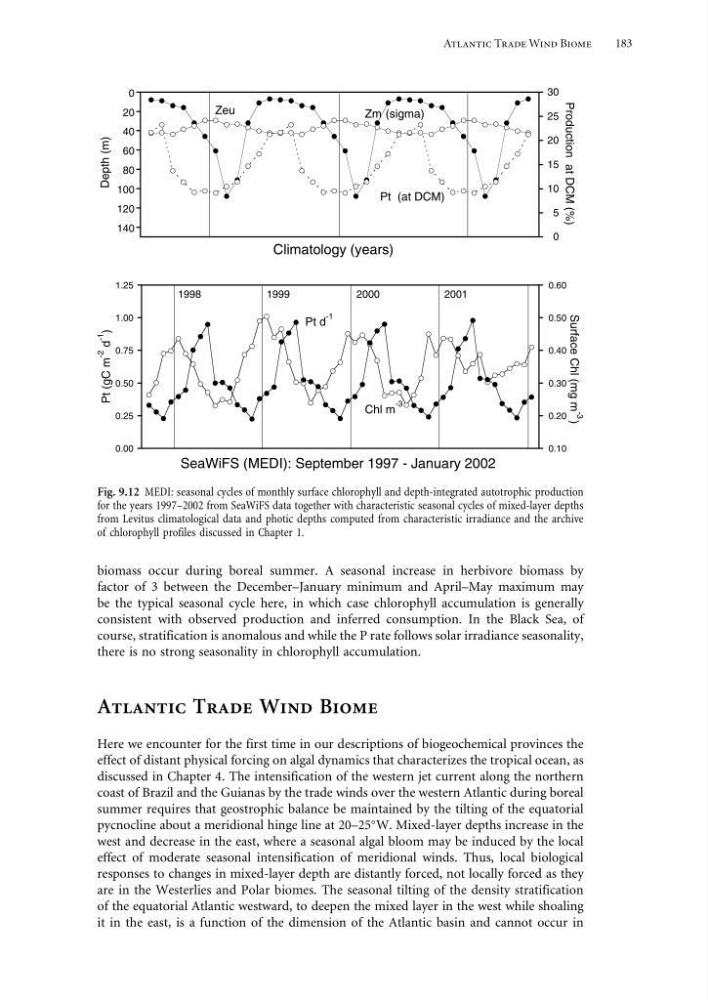
Fig. 9.12 MEDI: seasonal cycles of monthly surface chlorophyll and depth-integrated autotrophic production
for the years 1997–2002 from SeaWiFS data together with characteristic seasonal cycles of mixed-layer depths
from Levitus climatological data and photic depths computed from characteristic irradiance and the archive
of chlorophyll profiles discussed in Chapter 1.
biomass occur during boreal summer. A seasonal increase in herbivore biomass by
factor of 3 between the December–January minimum and April–May maximum may
be the typical seasonal cycle here, in which case chlorophyll accumulation is generally
consistent with observed production and inferred consumption. In the Black Sea, of
course, stratification is anomalous and while the P rate follows solar irradiance seasonality,
there is no strong seasonality in chlorophyll accumulation.
Atlantic Trade Wind Biome
Here we encounter for the first time in our descriptions of biogeochemical provinces the
effect of distant physical forcing on algal dynamics that characterizes the tropical ocean, as
discussed in Chapter 4. The intensification of the western jet current along the northern
coast of Brazil and the Guianas by the trade winds over the western Atlantic during boreal
summer requires that geostrophic balance be maintained by the tilting of the equatorial
pycnocline about a meridional hinge line at 20–25
W. Mixed-layer depths increase in the
west and decrease in the east, where a seasonal algal bloom may be induced by the local
effect of moderate seasonal intensification of meridional winds. Thus, local biological
responses to changes in mixed-layer depth are distantly forced, not locally forced as they
are in the Westerlies and Polar biomes. The seasonal tilting of the density stratification
of the equatorial Atlantic westward, to deepen the mixed layer in the west while shoaling
it in the east, is a function of the dimension of the Atlantic basin and cannot occur in
183
0
20
40
60
80
100
120
140
0
5
10
15
20
25
30
Climatology (years)
Depth (m)
Production at DCM (%)
Zm (sigma)
Zeu
Pt (at DCM)
0.00
0.25
0.50
0.75
1.00
1.25
0.10
0.20
0.30
0.40
0.50
0.60
SeaWiFS (MEDI): September 1997 - January 2002
Surface Chl (mg m -3
)
Pt (gC m
-2
d
-1
)
Pt d
-1
Chl m
-3
1998
1999
2000
2001
Fig. 9.12 MEDI: seasonal cycles of monthly surface chlorophyll and depth-integrated autotrophic production
for the years 1997–2002 from SeaWiFS data together with characteristic seasonal cycles of mixed-layer depths
from Levitus climatological data and photic depths computed from characteristic irradiance and the archive
of chlorophyll profiles discussed in Chapter 1.
biomass occur during boreal summer. A seasonal increase in herbivore biomass by
factor of 3 between the December–January minimum and April–May maximum may
be the typical seasonal cycle here, in which case chlorophyll accumulation is generally
consistent with observed production and inferred consumption. In the Black Sea, of
course, stratification is anomalous and while the P rate follows solar irradiance seasonality,
there is no strong seasonality in chlorophyll accumulation.
Atlantic Trade Wind Biome
Here we encounter for the first time in our descriptions of biogeochemical provinces the
effect of distant physical forcing on algal dynamics that characterizes the tropical ocean, as
discussed in Chapter 4. The intensification of the western jet current along the northern
coast of Brazil and the Guianas by the trade winds over the western Atlantic during boreal
summer requires that geostrophic balance be maintained by the tilting of the equatorial
pycnocline about a meridional hinge line at 20–25
W. Mixed-layer depths increase in the
west and decrease in the east, where a seasonal algal bloom may be induced by the local
effect of moderate seasonal intensification of meridional winds. Thus, local biological
responses to changes in mixed-layer depth are distantly forced, not locally forced as they
are in the Westerlies and Polar biomes. The seasonal tilting of the density stratification
of the equatorial Atlantic westward, to deepen the mixed layer in the west while shoaling
it in the east, is a function of the dimension of the Atlantic basin and cannot occur in