

Atlantic Westerly Winds Biome
175
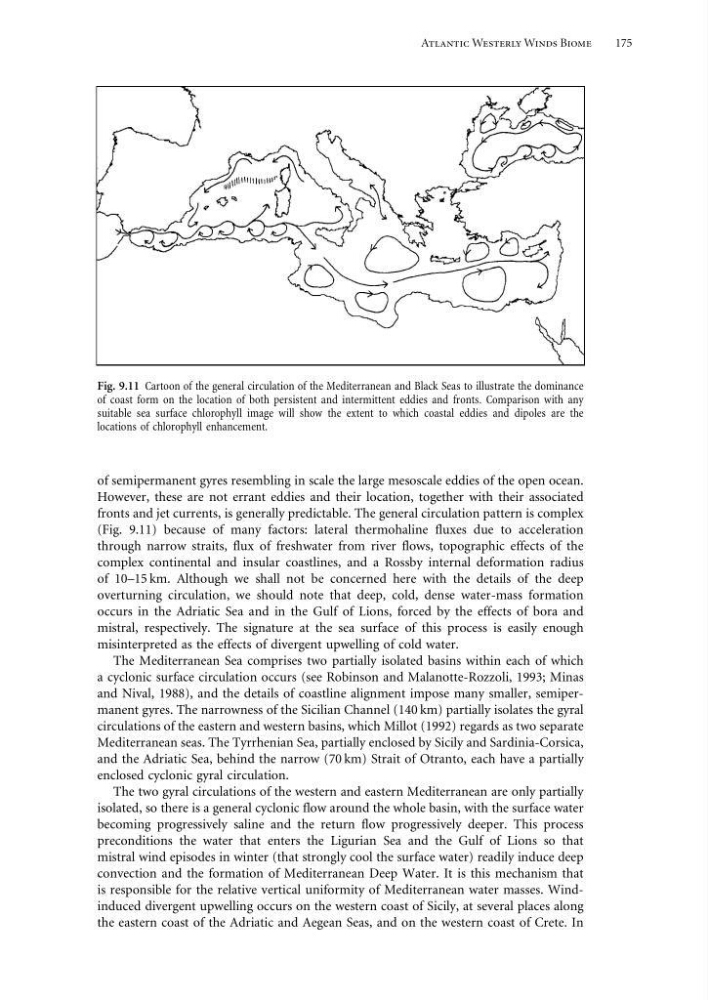
Fig. 9.11 Cartoon of the general circulation of the Mediterranean and Black Seas to illustrate the dominance
of coast form on the location of both persistent and intermittent eddies and fronts. Comparison with any
suitable sea surface chlorophyll image will show the extent to which coastal eddies and dipoles are the
locations of chlorophyll enhancement.
of semipermanent gyres resembling in scale the large mesoscale eddies of the open ocean.
However, these are not errant eddies and their location, together with their associated
fronts and jet currents, is generally predictable. The general circulation pattern is complex
(Fig. 9.11) because of many factors: lateral thermohaline fluxes due to acceleration
through narrow straits, flux of freshwater from river flows, topographic effects of the
complex continental and insular coastlines, and a Rossby internal deformation radius
of 10–15 km. Although we shall not be concerned here with the details of the deep
overturning circulation, we should note that deep, cold, dense water-mass formation
occurs in the Adriatic Sea and in the Gulf of Lions, forced by the effects of bora and
mistral, respectively. The signature at the sea surface of this process is easily enough
misinterpreted as the effects of divergent upwelling of cold water.
The Mediterranean Sea comprises two partially isolated basins within each of which
a cyclonic surface circulation occurs (see Robinson and Malanotte-Rozzoli, 1993; Minas
and Nival, 1988), and the details of coastline alignment impose many smaller, semipermanent gyres. The narrowness of the Sicilian Channel (140 km) partially isolates the gyral
circulations of the eastern and western basins, which Millot (1992) regards as two separate
Mediterranean seas. The Tyrrhenian Sea, partially enclosed by Sicily and Sardinia-Corsica,
and the Adriatic Sea, behind the narrow (70 km) Strait of Otranto, each have a partially
enclosed cyclonic gyral circulation.
The two gyral circulations of the western and eastern Mediterranean are only partially
isolated, so there is a general cyclonic flow around the whole basin, with the surface water
becoming progressively saline and the return flow progressively deeper. This process
preconditions the water that enters the Ligurian Sea and the Gulf of Lions so that
mistral wind episodes in winter (that strongly cool the surface water) readily induce deep
convection and the formation of Mediterranean Deep Water. It is this mechanism that
is responsible for the relative vertical uniformity of Mediterranean water masses. Windinduced divergent upwelling occurs on the western coast of Sicily, at several places along
the eastern coast of the Adriatic and Aegean Seas, and on the western coast of Crete. In
175
Fig. 9.11 Cartoon of the general circulation of the Mediterranean and Black Seas to illustrate the dominance
of coast form on the location of both persistent and intermittent eddies and fronts. Comparison with any
suitable sea surface chlorophyll image will show the extent to which coastal eddies and dipoles are the
locations of chlorophyll enhancement.
of semipermanent gyres resembling in scale the large mesoscale eddies of the open ocean.
However, these are not errant eddies and their location, together with their associated
fronts and jet currents, is generally predictable. The general circulation pattern is complex
(Fig. 9.11) because of many factors: lateral thermohaline fluxes due to acceleration
through narrow straits, flux of freshwater from river flows, topographic effects of the
complex continental and insular coastlines, and a Rossby internal deformation radius
of 10–15 km. Although we shall not be concerned here with the details of the deep
overturning circulation, we should note that deep, cold, dense water-mass formation
occurs in the Adriatic Sea and in the Gulf of Lions, forced by the effects of bora and
mistral, respectively. The signature at the sea surface of this process is easily enough
misinterpreted as the effects of divergent upwelling of cold water.
The Mediterranean Sea comprises two partially isolated basins within each of which
a cyclonic surface circulation occurs (see Robinson and Malanotte-Rozzoli, 1993; Minas
and Nival, 1988), and the details of coastline alignment impose many smaller, semipermanent gyres. The narrowness of the Sicilian Channel (140 km) partially isolates the gyral
circulations of the eastern and western basins, which Millot (1992) regards as two separate
Mediterranean seas. The Tyrrhenian Sea, partially enclosed by Sicily and Sardinia-Corsica,
and the Adriatic Sea, behind the narrow (70 km) Strait of Otranto, each have a partially
enclosed cyclonic gyral circulation.
The two gyral circulations of the western and eastern Mediterranean are only partially
isolated, so there is a general cyclonic flow around the whole basin, with the surface water
becoming progressively saline and the return flow progressively deeper. This process
preconditions the water that enters the Ligurian Sea and the Gulf of Lions so that
mistral wind episodes in winter (that strongly cool the surface water) readily induce deep
convection and the formation of Mediterranean Deep Water. It is this mechanism that
is responsible for the relative vertical uniformity of Mediterranean water masses. Windinduced divergent upwelling occurs on the western coast of Sicily, at several places along
the eastern coast of the Adriatic and Aegean Seas, and on the western coast of Crete. In