

170
Chapter 9: The Atlantic Ocean
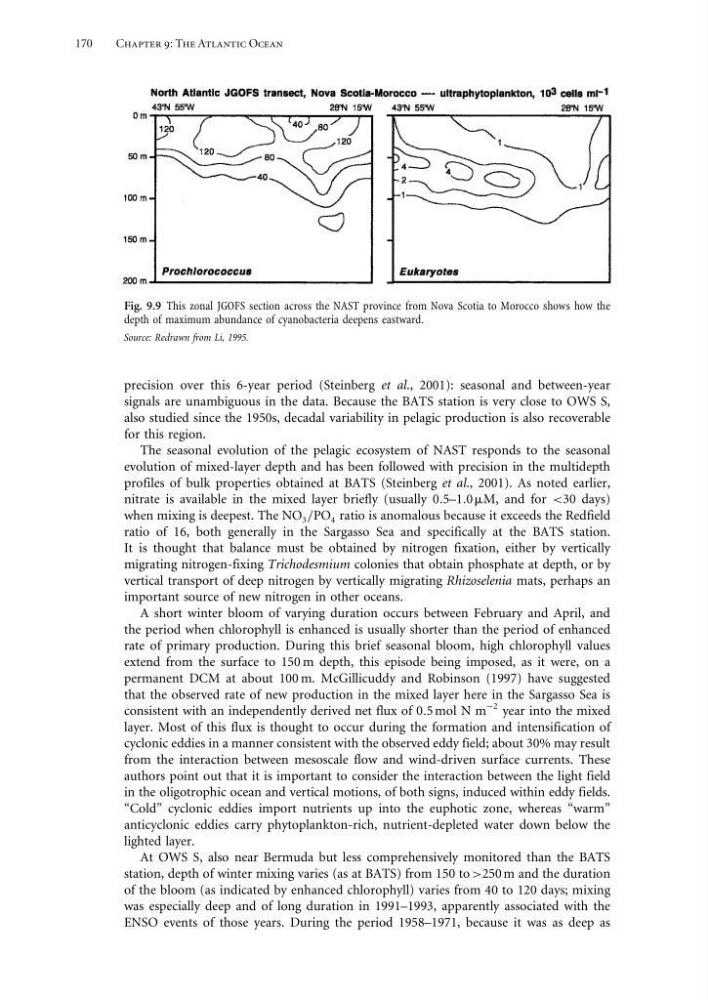
Fig. 9.9 This zonal JGOFS section across the NAST province from Nova Scotia to Morocco shows how the
depth of maximum abundance of cyanobacteria deepens eastward.
Source: Redrawn from Li, 1995.
precision over this 6-year period (Steinberg et al., 2001): seasonal and between-year
signals are unambiguous in the data. Because the BATS station is very close to OWS S,
also studied since the 1950s, decadal variability in pelagic production is also recoverable
for this region.
The seasonal evolution of the pelagic ecosystem of NAST responds to the seasonal
evolution of mixed-layer depth and has been followed with precision in the multidepth
profiles of bulk properties obtained at BATS (Steinberg et al., 2001). As noted earlier,
nitrate is available in the mixed layer briefly (usually 05–10 M, and for <30 days)
when mixing is deepest. The NO 3 /PO 4 ratio is anomalous because it exceeds the Redfield
ratio of 16, both generally in the Sargasso Sea and specifically at the BATS station.
It is thought that balance must be obtained by nitrogen fixation, either by vertically
migrating nitrogen-fixing Trichodesmium colonies that obtain phosphate at depth, or by
vertical transport of deep nitrogen by vertically migrating Rhizoselenia mats, perhaps an
important source of new nitrogen in other oceans.
A short winter bloom of varying duration occurs between February and April, and
the period when chlorophyll is enhanced is usually shorter than the period of enhanced
rate of primary production. During this brief seasonal bloom, high chlorophyll values
extend from the surface to 150 m depth, this episode being imposed, as it were, on a
permanent DCM at about 100 m. McGillicuddy and Robinson (1997) have suggested
that the observed rate of new production in the mixed layer here in the Sargasso Sea is
consistent with an independently derived net flux of 05 mol N m
−2 year into the mixed
layer. Most of this flux is thought to occur during the formation and intensification of
cyclonic eddies in a manner consistent with the observed eddy field; about 30% may result
from the interaction between mesoscale flow and wind-driven surface currents. These
authors point out that it is important to consider the interaction between the light field
in the oligotrophic ocean and vertical motions, of both signs, induced within eddy fields.
“Cold” cyclonic eddies import nutrients up into the euphotic zone, whereas “warm”
anticyclonic eddies carry phytoplankton-rich, nutrient-depleted water down below the
lighted layer.
At OWS S, also near Bermuda but less comprehensively monitored than the BATS
station, depth of winter mixing varies (as at BATS) from 150 to >250 m and the duration
of the bloom (as indicated by enhanced chlorophyll) varies from 40 to 120 days; mixing
was especially deep and of long duration in 1991–1993, apparently associated with the
ENSO events of those years. During the period 1958–1971, because it was as deep as
Chapter 9: The Atlantic Ocean
Fig. 9.9 This zonal JGOFS section across the NAST province from Nova Scotia to Morocco shows how the
depth of maximum abundance of cyanobacteria deepens eastward.
Source: Redrawn from Li, 1995.
precision over this 6-year period (Steinberg et al., 2001): seasonal and between-year
signals are unambiguous in the data. Because the BATS station is very close to OWS S,
also studied since the 1950s, decadal variability in pelagic production is also recoverable
for this region.
The seasonal evolution of the pelagic ecosystem of NAST responds to the seasonal
evolution of mixed-layer depth and has been followed with precision in the multidepth
profiles of bulk properties obtained at BATS (Steinberg et al., 2001). As noted earlier,
nitrate is available in the mixed layer briefly (usually 05–10 M, and for <30 days)
when mixing is deepest. The NO 3 /PO 4 ratio is anomalous because it exceeds the Redfield
ratio of 16, both generally in the Sargasso Sea and specifically at the BATS station.
It is thought that balance must be obtained by nitrogen fixation, either by vertically
migrating nitrogen-fixing Trichodesmium colonies that obtain phosphate at depth, or by
vertical transport of deep nitrogen by vertically migrating Rhizoselenia mats, perhaps an
important source of new nitrogen in other oceans.
A short winter bloom of varying duration occurs between February and April, and
the period when chlorophyll is enhanced is usually shorter than the period of enhanced
rate of primary production. During this brief seasonal bloom, high chlorophyll values
extend from the surface to 150 m depth, this episode being imposed, as it were, on a
permanent DCM at about 100 m. McGillicuddy and Robinson (1997) have suggested
that the observed rate of new production in the mixed layer here in the Sargasso Sea is
consistent with an independently derived net flux of 05 mol N m
−2 year into the mixed
layer. Most of this flux is thought to occur during the formation and intensification of
cyclonic eddies in a manner consistent with the observed eddy field; about 30% may result
from the interaction between mesoscale flow and wind-driven surface currents. These
authors point out that it is important to consider the interaction between the light field
in the oligotrophic ocean and vertical motions, of both signs, induced within eddy fields.
“Cold” cyclonic eddies import nutrients up into the euphotic zone, whereas “warm”
anticyclonic eddies carry phytoplankton-rich, nutrient-depleted water down below the
lighted layer.
At OWS S, also near Bermuda but less comprehensively monitored than the BATS
station, depth of winter mixing varies (as at BATS) from 150 to >250 m and the duration
of the bloom (as indicated by enhanced chlorophyll) varies from 40 to 120 days; mixing
was especially deep and of long duration in 1991–1993, apparently associated with the
ENSO events of those years. During the period 1958–1971, because it was as deep as