

Atlantic Westerly Winds Biome
167
0.00
0.30
0.60
0.90
1.20
1.50
0.00
0.20
0.40
0.60
0.80
1.00
SeaWiFS (GFST): September 1997 - January 2002
Surface Chl (mg m -3
)
Pt d
-1
Chl m
-3
1998
1999
2000
2001
Pt (gC m
-2
d
-1
)
0
20
40
60
80
100
120
140
0
5
10
15
20
25
30
Climatology (years)
Depth (m)
Production at DCM (%)
Zm (sigma)
Zeu
Pt (at DCM)
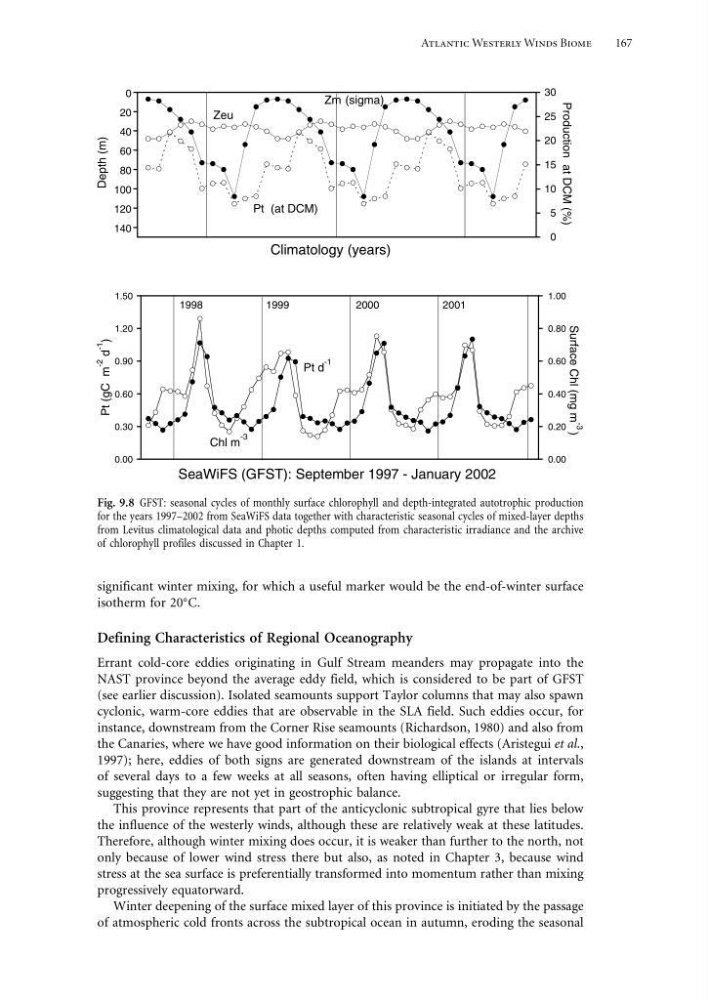
Fig. 9.8 GFST: seasonal cycles of monthly surface chlorophyll and depth-integrated autotrophic production
for the years 1997–2002 from SeaWiFS data together with characteristic seasonal cycles of mixed-layer depths
from Levitus climatological data and photic depths computed from characteristic irradiance and the archive
of chlorophyll profiles discussed in Chapter 1.
significant winter mixing, for which a useful marker would be the end-of-winter surface
isotherm for 20
C.
Defining Characteristics of Regional Oceanography
Errant cold-core eddies originating in Gulf Stream meanders may propagate into the
NAST province beyond the average eddy field, which is considered to be part of GFST
(see earlier discussion). Isolated seamounts support Taylor columns that may also spawn
cyclonic, warm-core eddies that are observable in the SLA field. Such eddies occur, for
instance, downstream from the Corner Rise seamounts (Richardson, 1980) and also from
the Canaries, where we have good information on their biological effects (Aristegui et al.,
1997); here, eddies of both signs are generated downstream of the islands at intervals
of several days to a few weeks at all seasons, often having elliptical or irregular form,
suggesting that they are not yet in geostrophic balance.
This province represents that part of the anticyclonic subtropical gyre that lies below
the influence of the westerly winds, although these are relatively weak at these latitudes.
Therefore, although winter mixing does occur, it is weaker than further to the north, not
only because of lower wind stress there but also, as noted in Chapter 3, because wind
stress at the sea surface is preferentially transformed into momentum rather than mixing
progressively equatorward.
Winter deepening of the surface mixed layer of this province is initiated by the passage
of atmospheric cold fronts across the subtropical ocean in autumn, eroding the seasonal
167
0.00
0.30
0.60
0.90
1.20
1.50
0.00
0.20
0.40
0.60
0.80
1.00
SeaWiFS (GFST): September 1997 - January 2002
Surface Chl (mg m -3
)
Pt d
-1
Chl m
-3
1998
1999
2000
2001
Pt (gC m
-2
d
-1
)
0
20
40
60
80
100
120
140
0
5
10
15
20
25
30
Climatology (years)
Depth (m)
Production at DCM (%)
Zm (sigma)
Zeu
Pt (at DCM)
Fig. 9.8 GFST: seasonal cycles of monthly surface chlorophyll and depth-integrated autotrophic production
for the years 1997–2002 from SeaWiFS data together with characteristic seasonal cycles of mixed-layer depths
from Levitus climatological data and photic depths computed from characteristic irradiance and the archive
of chlorophyll profiles discussed in Chapter 1.
significant winter mixing, for which a useful marker would be the end-of-winter surface
isotherm for 20
C.
Defining Characteristics of Regional Oceanography
Errant cold-core eddies originating in Gulf Stream meanders may propagate into the
NAST province beyond the average eddy field, which is considered to be part of GFST
(see earlier discussion). Isolated seamounts support Taylor columns that may also spawn
cyclonic, warm-core eddies that are observable in the SLA field. Such eddies occur, for
instance, downstream from the Corner Rise seamounts (Richardson, 1980) and also from
the Canaries, where we have good information on their biological effects (Aristegui et al.,
1997); here, eddies of both signs are generated downstream of the islands at intervals
of several days to a few weeks at all seasons, often having elliptical or irregular form,
suggesting that they are not yet in geostrophic balance.
This province represents that part of the anticyclonic subtropical gyre that lies below
the influence of the westerly winds, although these are relatively weak at these latitudes.
Therefore, although winter mixing does occur, it is weaker than further to the north, not
only because of lower wind stress there but also, as noted in Chapter 3, because wind
stress at the sea surface is preferentially transformed into momentum rather than mixing
progressively equatorward.
Winter deepening of the surface mixed layer of this province is initiated by the passage
of atmospheric cold fronts across the subtropical ocean in autumn, eroding the seasonal