

164
Chapter 9: The Atlantic Ocean
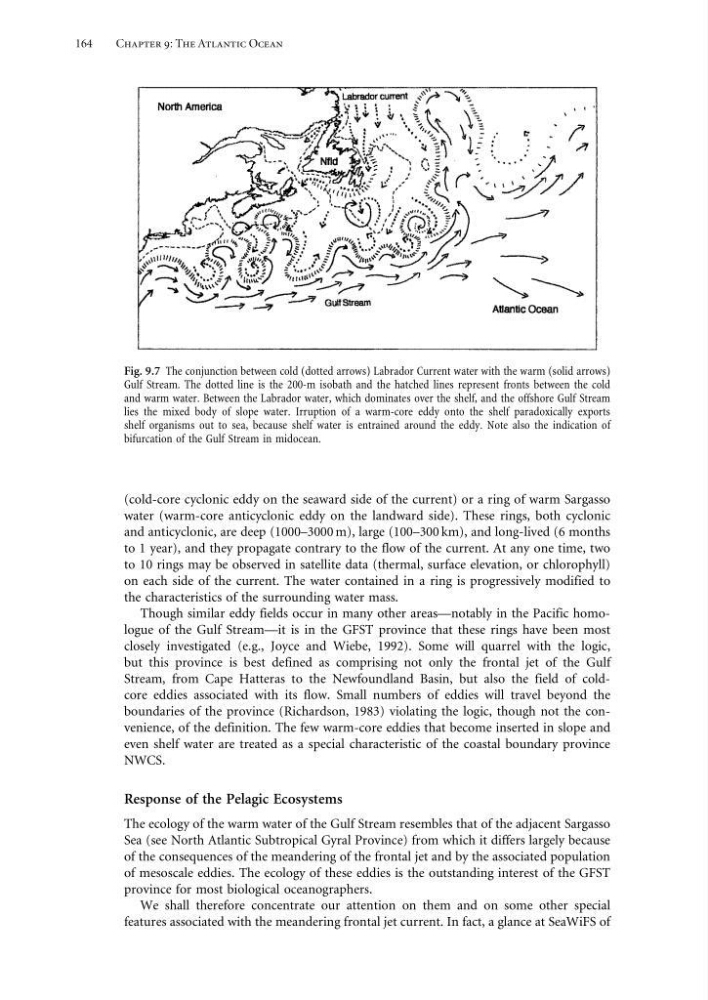
Fig. 9.7 The conjunction between cold (dotted arrows) Labrador Current water with the warm (solid arrows)
Gulf Stream. The dotted line is the 200-m isobath and the hatched lines represent fronts between the cold
and warm water. Between the Labrador water, which dominates over the shelf, and the offshore Gulf Stream
lies the mixed body of slope water. Irruption of a warm-core eddy onto the shelf paradoxically exports
shelf organisms out to sea, because shelf water is entrained around the eddy. Note also the indication of
bifurcation of the Gulf Stream in midocean.
(cold-core cyclonic eddy on the seaward side of the current) or a ring of warm Sargasso
water (warm-core anticyclonic eddy on the landward side). These rings, both cyclonic
and anticyclonic, are deep (1000–3000 m), large (100–300 km), and long-lived (6 months
to 1 year), and they propagate contrary to the flow of the current. At any one time, two
to 10 rings may be observed in satellite data (thermal, surface elevation, or chlorophyll)
on each side of the current. The water contained in a ring is progressively modified to
the characteristics of the surrounding water mass.
Though similar eddy fields occur in many other areas—notably in the Pacific homologue of the Gulf Stream—it is in the GFST province that these rings have been most
closely investigated (e.g., Joyce and Wiebe, 1992). Some will quarrel with the logic,
but this province is best defined as comprising not only the frontal jet of the Gulf
Stream, from Cape Hatteras to the Newfoundland Basin, but also the field of coldcore eddies associated with its flow. Small numbers of eddies will travel beyond the
boundaries of the province (Richardson, 1983) violating the logic, though not the convenience, of the definition. The few warm-core eddies that become inserted in slope and
even shelf water are treated as a special characteristic of the coastal boundary province
NWCS.
Response of the Pelagic Ecosystems
The ecology of the warm water of the Gulf Stream resembles that of the adjacent Sargasso
Sea (see North Atlantic Subtropical Gyral Province) from which it differs largely because
of the consequences of the meandering of the frontal jet and by the associated population
of mesoscale eddies. The ecology of these eddies is the outstanding interest of the GFST
province for most biological oceanographers.
We shall therefore concentrate our attention on them and on some other special
features associated with the meandering frontal jet current. In fact, a glance at SeaWiFS of
Chapter 9: The Atlantic Ocean
Fig. 9.7 The conjunction between cold (dotted arrows) Labrador Current water with the warm (solid arrows)
Gulf Stream. The dotted line is the 200-m isobath and the hatched lines represent fronts between the cold
and warm water. Between the Labrador water, which dominates over the shelf, and the offshore Gulf Stream
lies the mixed body of slope water. Irruption of a warm-core eddy onto the shelf paradoxically exports
shelf organisms out to sea, because shelf water is entrained around the eddy. Note also the indication of
bifurcation of the Gulf Stream in midocean.
(cold-core cyclonic eddy on the seaward side of the current) or a ring of warm Sargasso
water (warm-core anticyclonic eddy on the landward side). These rings, both cyclonic
and anticyclonic, are deep (1000–3000 m), large (100–300 km), and long-lived (6 months
to 1 year), and they propagate contrary to the flow of the current. At any one time, two
to 10 rings may be observed in satellite data (thermal, surface elevation, or chlorophyll)
on each side of the current. The water contained in a ring is progressively modified to
the characteristics of the surrounding water mass.
Though similar eddy fields occur in many other areas—notably in the Pacific homologue of the Gulf Stream—it is in the GFST province that these rings have been most
closely investigated (e.g., Joyce and Wiebe, 1992). Some will quarrel with the logic,
but this province is best defined as comprising not only the frontal jet of the Gulf
Stream, from Cape Hatteras to the Newfoundland Basin, but also the field of coldcore eddies associated with its flow. Small numbers of eddies will travel beyond the
boundaries of the province (Richardson, 1983) violating the logic, though not the convenience, of the definition. The few warm-core eddies that become inserted in slope and
even shelf water are treated as a special characteristic of the coastal boundary province
NWCS.
Response of the Pelagic Ecosystems
The ecology of the warm water of the Gulf Stream resembles that of the adjacent Sargasso
Sea (see North Atlantic Subtropical Gyral Province) from which it differs largely because
of the consequences of the meandering of the frontal jet and by the associated population
of mesoscale eddies. The ecology of these eddies is the outstanding interest of the GFST
province for most biological oceanographers.
We shall therefore concentrate our attention on them and on some other special
features associated with the meandering frontal jet current. In fact, a glance at SeaWiFS of