

162
Chapter 9: The Atlantic Ocean
layers exceeding 200 m everywhere along the section. These migrants lay, by day, in
species- and stage-specific strata of only a few meters depth each, readily separable in
the LHPR profiles. Diel vertical migration of these interzonal forms added 125–150% of
biomass to the epiplankton at night.
Parin remarks that holoepipelagic fishes are relatively sparse in the boreal North
Atlantic, and perhaps the most significant species in the open ocean is the saury (Scombresox saurus), which appears to fill the same ecological niche as the flying fishes of
tropical seas. This species spawns in subtropical seas, especially the Caribbean, but makes
extensive summer feeding migrations throughout the open North Atlantic. The very large
bluefin (Thunnus thynnus) that spawn in the Sargasso Sea of the NAST province, adjacent
to the south, are the only tuna species in NADR; like saury, bluefin perform seasonal
feeding migrations along the general path of the oceanic Gulf Stream.
Synopsis
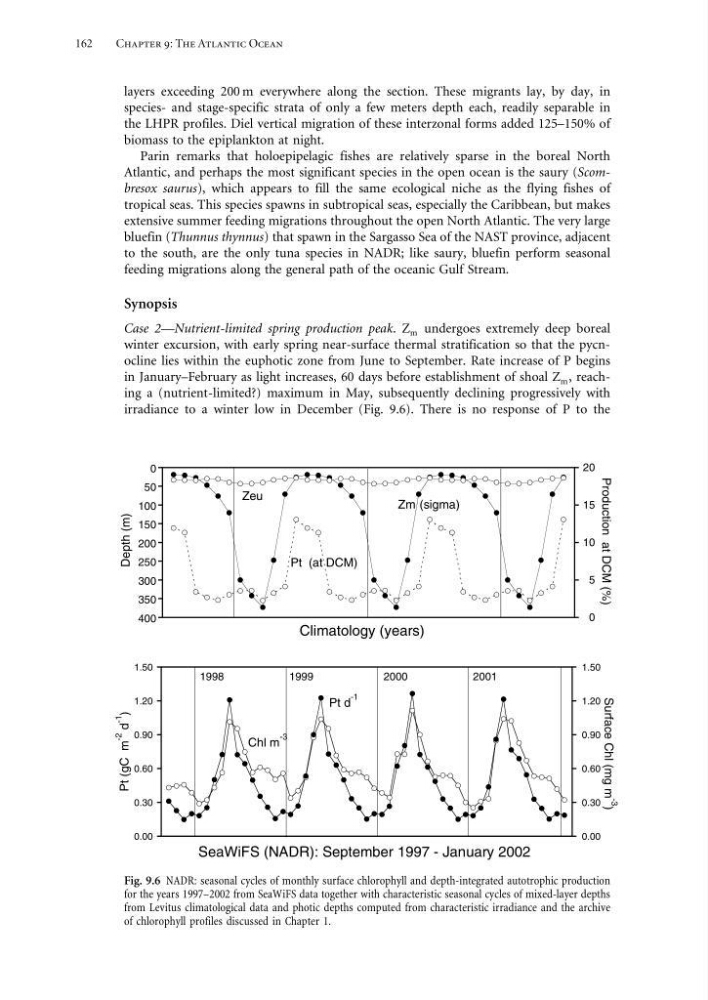
Case 2—Nutrient-limited spring production peak. Z m undergoes extremely deep boreal
winter excursion, with early spring near-surface thermal stratification so that the pycnocline lies within the euphotic zone from June to September. Rate increase of P begins
in January–February as light increases, 60 days before establishment of shoal Z m , reaching a (nutrient-limited?) maximum in May, subsequently declining progressively with
irradiance to a winter low in December (Fig. 9.6). There is no response of P to the
0
50
100
150
200
250
300
350
400
0
5
10
15
20
Climatology (years)
Depth (m)
Production at DCM (%)
Zm (sigma)
Zeu
Pt (at DCM)
0.00
0.30
0.60
0.90
1.20
1.50
0.00
0.30
0.60
0.90
1.20
1.50
SeaWiFS (NADR): September 1997 - January 2002
Surface Chl (mg m -3
)
Pt d
-1
Chl m
-3
Pt (gC m
-2
d
-1
)
1998
1999
2000
2001
Fig. 9.6 NADR: seasonal cycles of monthly surface chlorophyll and depth-integrated autotrophic production
for the years 1997–2002 from SeaWiFS data together with characteristic seasonal cycles of mixed-layer depths
from Levitus climatological data and photic depths computed from characteristic irradiance and the archive
of chlorophyll profiles discussed in Chapter 1.
Chapter 9: The Atlantic Ocean
layers exceeding 200 m everywhere along the section. These migrants lay, by day, in
species- and stage-specific strata of only a few meters depth each, readily separable in
the LHPR profiles. Diel vertical migration of these interzonal forms added 125–150% of
biomass to the epiplankton at night.
Parin remarks that holoepipelagic fishes are relatively sparse in the boreal North
Atlantic, and perhaps the most significant species in the open ocean is the saury (Scombresox saurus), which appears to fill the same ecological niche as the flying fishes of
tropical seas. This species spawns in subtropical seas, especially the Caribbean, but makes
extensive summer feeding migrations throughout the open North Atlantic. The very large
bluefin (Thunnus thynnus) that spawn in the Sargasso Sea of the NAST province, adjacent
to the south, are the only tuna species in NADR; like saury, bluefin perform seasonal
feeding migrations along the general path of the oceanic Gulf Stream.
Synopsis
Case 2—Nutrient-limited spring production peak. Z m undergoes extremely deep boreal
winter excursion, with early spring near-surface thermal stratification so that the pycnocline lies within the euphotic zone from June to September. Rate increase of P begins
in January–February as light increases, 60 days before establishment of shoal Z m , reaching a (nutrient-limited?) maximum in May, subsequently declining progressively with
irradiance to a winter low in December (Fig. 9.6). There is no response of P to the
0
50
100
150
200
250
300
350
400
0
5
10
15
20
Climatology (years)
Depth (m)
Production at DCM (%)
Zm (sigma)
Zeu
Pt (at DCM)
0.00
0.30
0.60
0.90
1.20
1.50
0.00
0.30
0.60
0.90
1.20
1.50
SeaWiFS (NADR): September 1997 - January 2002
Surface Chl (mg m -3
)
Pt d
-1
Chl m
-3
Pt (gC m
-2
d
-1
)
1998
1999
2000
2001
Fig. 9.6 NADR: seasonal cycles of monthly surface chlorophyll and depth-integrated autotrophic production
for the years 1997–2002 from SeaWiFS data together with characteristic seasonal cycles of mixed-layer depths
from Levitus climatological data and photic depths computed from characteristic irradiance and the archive
of chlorophyll profiles discussed in Chapter 1.