

156
Chapter 9: The Atlantic Ocean
0
50
100
150
200
250
0
5
10
15
20
Climatology (years)
Depth (m)
Production at DCM (%)
Zm (sigma)
Zeu
Pt (at DCM)
0.00
0.25
0.50
0.75
1.00
1.25
0.00
0.60
1.20
1.80
2.40
3.00
SeaWiFS (SARC): September 1997 - January 2002
Surface Chl (mg m -3
)
Pt d
-1
Chl m
-3
Pt (gC m
-2
d
-1
)
1998
1999
2000
2001
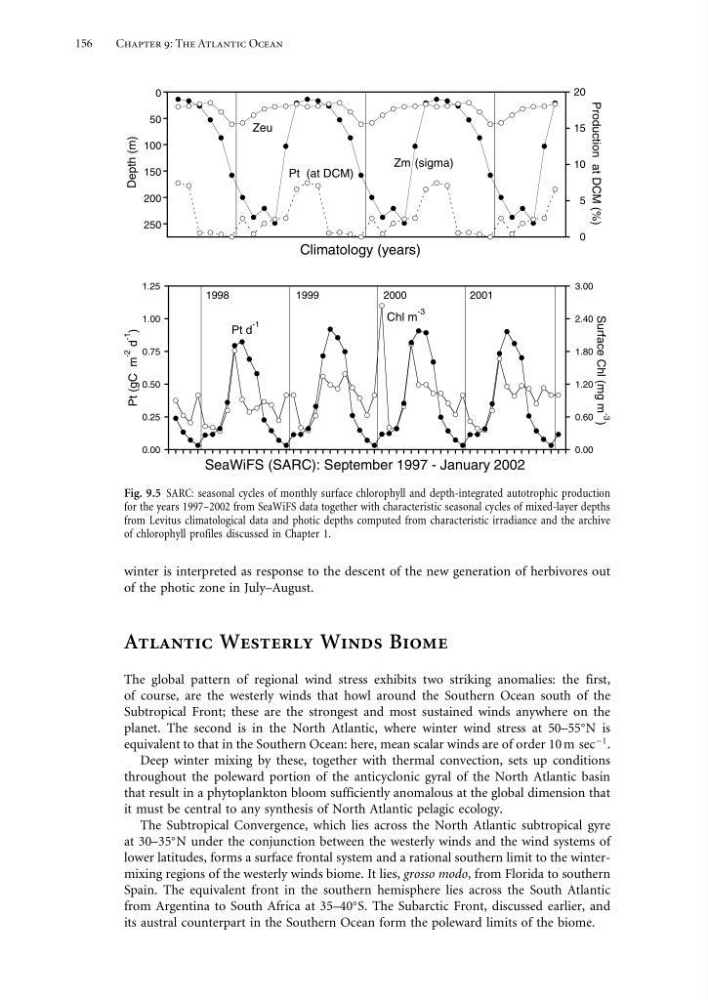
Fig. 9.5 SARC: seasonal cycles of monthly surface chlorophyll and depth-integrated autotrophic production
for the years 1997–2002 from SeaWiFS data together with characteristic seasonal cycles of mixed-layer depths
from Levitus climatological data and photic depths computed from characteristic irradiance and the archive
of chlorophyll profiles discussed in Chapter 1.
winter is interpreted as response to the descent of the new generation of herbivores out
of the photic zone in July–August.
Atlantic Westerly Winds Biome
The global pattern of regional wind stress exhibits two striking anomalies: the first,
of course, are the westerly winds that howl around the Southern Ocean south of the
Subtropical Front; these are the strongest and most sustained winds anywhere on the
planet. The second is in the North Atlantic, where winter wind stress at 50–55
N is
equivalent to that in the Southern Ocean: here, mean scalar winds are of order 10 m sec
−1 .
Deep winter mixing by these, together with thermal convection, sets up conditions
throughout the poleward portion of the anticyclonic gyral of the North Atlantic basin
that result in a phytoplankton bloom sufficiently anomalous at the global dimension that
it must be central to any synthesis of North Atlantic pelagic ecology.
The Subtropical Convergence, which lies across the North Atlantic subtropical gyre
at 30–35
N under the conjunction between the westerly winds and the wind systems of
lower latitudes, forms a surface frontal system and a rational southern limit to the wintermixing regions of the westerly winds biome. It lies, grosso modo, from Florida to southern
Spain. The equivalent front in the southern hemisphere lies across the South Atlantic
from Argentina to South Africa at 35–40
S. The Subarctic Front, discussed earlier, and
its austral counterpart in the Southern Ocean form the poleward limits of the biome.
Chapter 9: The Atlantic Ocean
0
50
100
150
200
250
0
5
10
15
20
Climatology (years)
Depth (m)
Production at DCM (%)
Zm (sigma)
Zeu
Pt (at DCM)
0.00
0.25
0.50
0.75
1.00
1.25
0.00
0.60
1.20
1.80
2.40
3.00
SeaWiFS (SARC): September 1997 - January 2002
Surface Chl (mg m -3
)
Pt d
-1
Chl m
-3
Pt (gC m
-2
d
-1
)
1998
1999
2000
2001
Fig. 9.5 SARC: seasonal cycles of monthly surface chlorophyll and depth-integrated autotrophic production
for the years 1997–2002 from SeaWiFS data together with characteristic seasonal cycles of mixed-layer depths
from Levitus climatological data and photic depths computed from characteristic irradiance and the archive
of chlorophyll profiles discussed in Chapter 1.
winter is interpreted as response to the descent of the new generation of herbivores out
of the photic zone in July–August.
Atlantic Westerly Winds Biome
The global pattern of regional wind stress exhibits two striking anomalies: the first,
of course, are the westerly winds that howl around the Southern Ocean south of the
Subtropical Front; these are the strongest and most sustained winds anywhere on the
planet. The second is in the North Atlantic, where winter wind stress at 50–55
N is
equivalent to that in the Southern Ocean: here, mean scalar winds are of order 10 m sec
−1 .
Deep winter mixing by these, together with thermal convection, sets up conditions
throughout the poleward portion of the anticyclonic gyral of the North Atlantic basin
that result in a phytoplankton bloom sufficiently anomalous at the global dimension that
it must be central to any synthesis of North Atlantic pelagic ecology.
The Subtropical Convergence, which lies across the North Atlantic subtropical gyre
at 30–35
N under the conjunction between the westerly winds and the wind systems of
lower latitudes, forms a surface frontal system and a rational southern limit to the wintermixing regions of the westerly winds biome. It lies, grosso modo, from Florida to southern
Spain. The equivalent front in the southern hemisphere lies across the South Atlantic
from Argentina to South Africa at 35–40
S. The Subarctic Front, discussed earlier, and
its austral counterpart in the Southern Ocean form the poleward limits of the biome.