

Atlantic Polar Biome
147
generation yearly, and the timing of the algal bloom in relation to egg laying appears to
determine recruitment success of the subsequent generation (Head et al., 2000, 2003).
When the bloom is early and intense, maturation of overwintered adults is rapid and eggs
are produced when phytoplankton concentrations are high. If the bloom is late, or weak,
maturation is delayed so that eggs are produced when phytoplankton concentrations are
low. In the latter case, not only will fewer eggs survive, but larvae will have a shorter
period to develop prior to entering the overwintering phase. In the later copepodite
stages, survival appears to be less dependent on phytoplankton availability.
The pelagic fish of most significance in this province is the capelin (Mallotus villosus), a
small (15–20 cm) osmerid smelt that is significant in the support of the extensive sea-bird
populations of the region. It is extremely abundant but very little appears to be known
of its pelagic ecology, save that its diet is dominated by copepods; the relations between
capelin and demersal fish will be touched on in the next section.
Synopsis
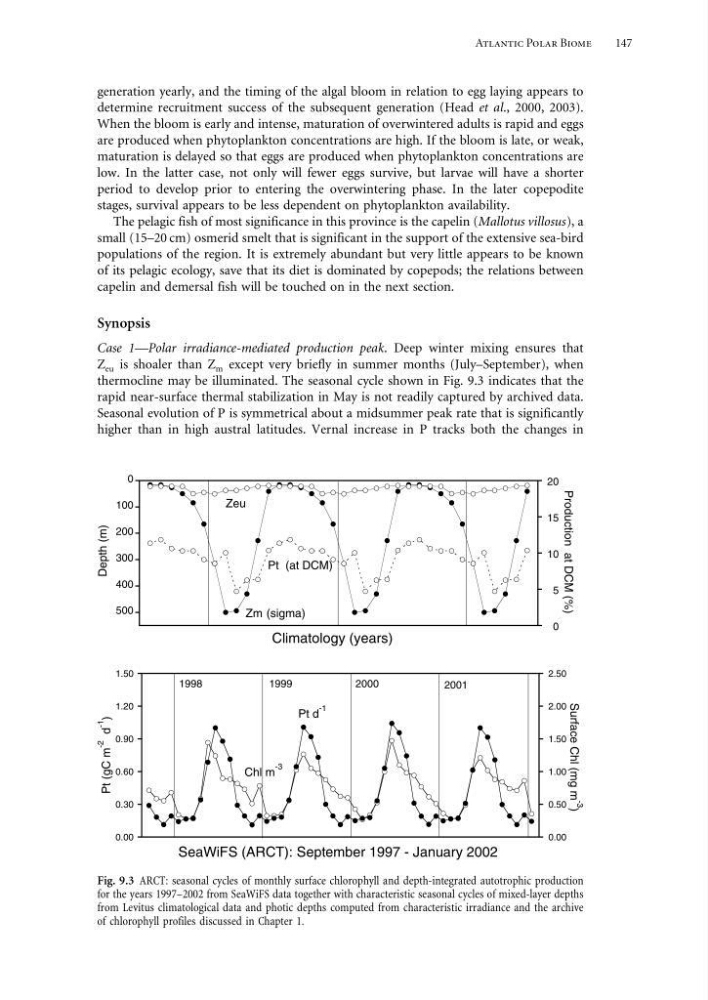
Case 1—Polar irradiance-mediated production peak. Deep winter mixing ensures that
Z eu is shoaler than Z m except very briefly in summer months (July–September), when
thermocline may be illuminated. The seasonal cycle shown in Fig. 9.3 indicates that the
rapid near-surface thermal stabilization in May is not readily captured by archived data.
Seasonal evolution of P is symmetrical about a midsummer peak rate that is significantly
higher than in high austral latitudes. Vernal increase in P tracks both the changes in
0
100
200
300
400
500
0
5
10
15
20
Climatology (years)
Depth (m)
Production at DCM (%)
Zm (sigma)
Zeu
Pt (at DCM)
0.00
0.30
0.60
0.90
1.20
1.50
0.00
0.50
1.00
1.50
2.00
2.50
SeaWiFS (ARCT): September 1997 - January 2002
Surface Chl (mg m -3
)
Pt (gC m
-2
d
-1
)
Pt d
-1
Chl m
-3
1998
1999
2000
2001
Fig. 9.3 ARCT: seasonal cycles of monthly surface chlorophyll and depth-integrated autotrophic production
for the years 1997–2002 from SeaWiFS data together with characteristic seasonal cycles of mixed-layer depths
from Levitus climatological data and photic depths computed from characteristic irradiance and the archive
of chlorophyll profiles discussed in Chapter 1.
147
generation yearly, and the timing of the algal bloom in relation to egg laying appears to
determine recruitment success of the subsequent generation (Head et al., 2000, 2003).
When the bloom is early and intense, maturation of overwintered adults is rapid and eggs
are produced when phytoplankton concentrations are high. If the bloom is late, or weak,
maturation is delayed so that eggs are produced when phytoplankton concentrations are
low. In the latter case, not only will fewer eggs survive, but larvae will have a shorter
period to develop prior to entering the overwintering phase. In the later copepodite
stages, survival appears to be less dependent on phytoplankton availability.
The pelagic fish of most significance in this province is the capelin (Mallotus villosus), a
small (15–20 cm) osmerid smelt that is significant in the support of the extensive sea-bird
populations of the region. It is extremely abundant but very little appears to be known
of its pelagic ecology, save that its diet is dominated by copepods; the relations between
capelin and demersal fish will be touched on in the next section.
Synopsis
Case 1—Polar irradiance-mediated production peak. Deep winter mixing ensures that
Z eu is shoaler than Z m except very briefly in summer months (July–September), when
thermocline may be illuminated. The seasonal cycle shown in Fig. 9.3 indicates that the
rapid near-surface thermal stabilization in May is not readily captured by archived data.
Seasonal evolution of P is symmetrical about a midsummer peak rate that is significantly
higher than in high austral latitudes. Vernal increase in P tracks both the changes in
0
100
200
300
400
500
0
5
10
15
20
Climatology (years)
Depth (m)
Production at DCM (%)
Zm (sigma)
Zeu
Pt (at DCM)
0.00
0.30
0.60
0.90
1.20
1.50
0.00
0.50
1.00
1.50
2.00
2.50
SeaWiFS (ARCT): September 1997 - January 2002
Surface Chl (mg m -3
)
Pt (gC m
-2
d
-1
)
Pt d
-1
Chl m
-3
1998
1999
2000
2001
Fig. 9.3 ARCT: seasonal cycles of monthly surface chlorophyll and depth-integrated autotrophic production
for the years 1997–2002 from SeaWiFS data together with characteristic seasonal cycles of mixed-layer depths
from Levitus climatological data and photic depths computed from characteristic irradiance and the archive
of chlorophyll profiles discussed in Chapter 1.