

Multidecadal Trends and Changes
127
0
5 10
4
1 10
5
1.5 10
5
2 10
5
2.5 10
5
3 10
5
500
550
600
650
700
750
800
Annual sardine catch (tonnes)
Sea level at Cochin
0
5 10
4
1 10
5
1.5 10
5
2 10
5
2.5 10
5
3 10
5
1900
1920
1940
1960
1980
Seasonal sardine landings (tons)
Years, 1896-1986
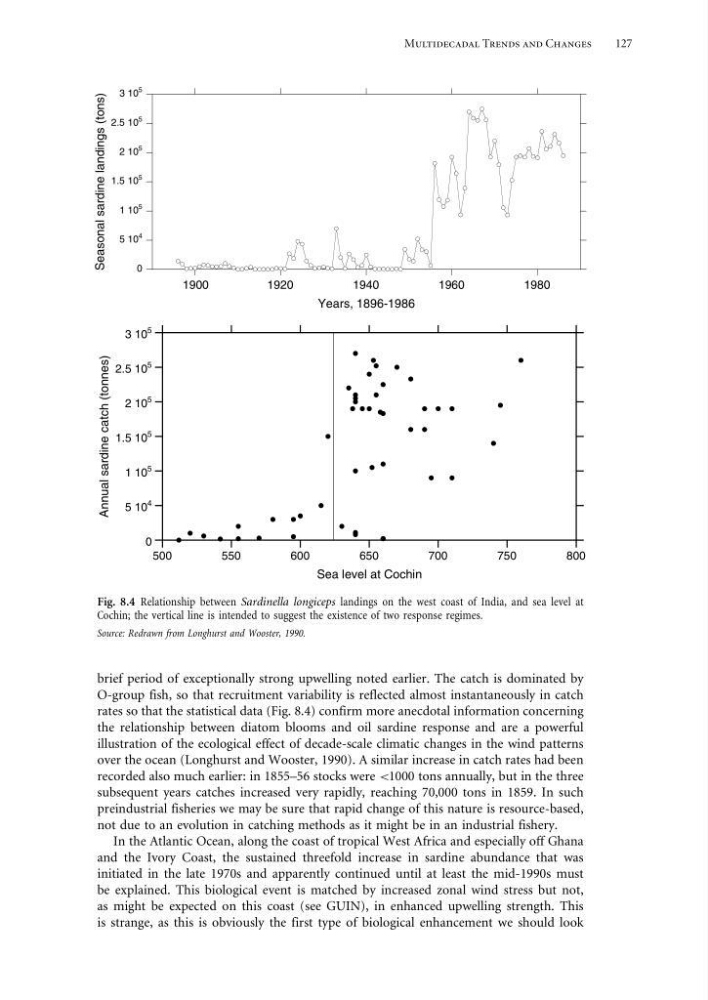
Fig. 8.4 Relationship between Sardinella longiceps landings on the west coast of India, and sea level at
Cochin; the vertical line is intended to suggest the existence of two response regimes.
Source: Redrawn from Longhurst and Wooster, 1990.
brief period of exceptionally strong upwelling noted earlier. The catch is dominated by
O-group fish, so that recruitment variability is reflected almost instantaneously in catch
rates so that the statistical data (Fig. 8.4) confirm more anecdotal information concerning
the relationship between diatom blooms and oil sardine response and are a powerful
illustration of the ecological effect of decade-scale climatic changes in the wind patterns
over the ocean (Longhurst and Wooster, 1990). A similar increase in catch rates had been
recorded also much earlier: in 1855–56 stocks were <1000 tons annually, but in the three
subsequent years catches increased very rapidly, reaching 70,000 tons in 1859. In such
preindustrial fisheries we may be sure that rapid change of this nature is resource-based,
not due to an evolution in catching methods as it might be in an industrial fishery.
In the Atlantic Ocean, along the coast of tropical West Africa and especially off Ghana
and the Ivory Coast, the sustained threefold increase in sardine abundance that was
initiated in the late 1970s and apparently continued until at least the mid-1990s must
be explained. This biological event is matched by increased zonal wind stress but not,
as might be expected on this coast (see GUIN), in enhanced upwelling strength. This
is strange, as this is obviously the first type of biological enhancement we should look
127
0
5 10
4
1 10
5
1.5 10
5
2 10
5
2.5 10
5
3 10
5
500
550
600
650
700
750
800
Annual sardine catch (tonnes)
Sea level at Cochin
0
5 10
4
1 10
5
1.5 10
5
2 10
5
2.5 10
5
3 10
5
1900
1920
1940
1960
1980
Seasonal sardine landings (tons)
Years, 1896-1986
Fig. 8.4 Relationship between Sardinella longiceps landings on the west coast of India, and sea level at
Cochin; the vertical line is intended to suggest the existence of two response regimes.
Source: Redrawn from Longhurst and Wooster, 1990.
brief period of exceptionally strong upwelling noted earlier. The catch is dominated by
O-group fish, so that recruitment variability is reflected almost instantaneously in catch
rates so that the statistical data (Fig. 8.4) confirm more anecdotal information concerning
the relationship between diatom blooms and oil sardine response and are a powerful
illustration of the ecological effect of decade-scale climatic changes in the wind patterns
over the ocean (Longhurst and Wooster, 1990). A similar increase in catch rates had been
recorded also much earlier: in 1855–56 stocks were <1000 tons annually, but in the three
subsequent years catches increased very rapidly, reaching 70,000 tons in 1859. In such
preindustrial fisheries we may be sure that rapid change of this nature is resource-based,
not due to an evolution in catching methods as it might be in an industrial fishery.
In the Atlantic Ocean, along the coast of tropical West Africa and especially off Ghana
and the Ivory Coast, the sustained threefold increase in sardine abundance that was
initiated in the late 1970s and apparently continued until at least the mid-1990s must
be explained. This biological event is matched by increased zonal wind stress but not,
as might be expected on this coast (see GUIN), in enhanced upwelling strength. This
is strange, as this is obviously the first type of biological enhancement we should look