

Multidecadal Trends and Changes
125
-6
-4
-2
0
2
4
6
1860
1880
1900
1920
1940
1960
1980
2000
North Atlantic Oscillation Index
Years
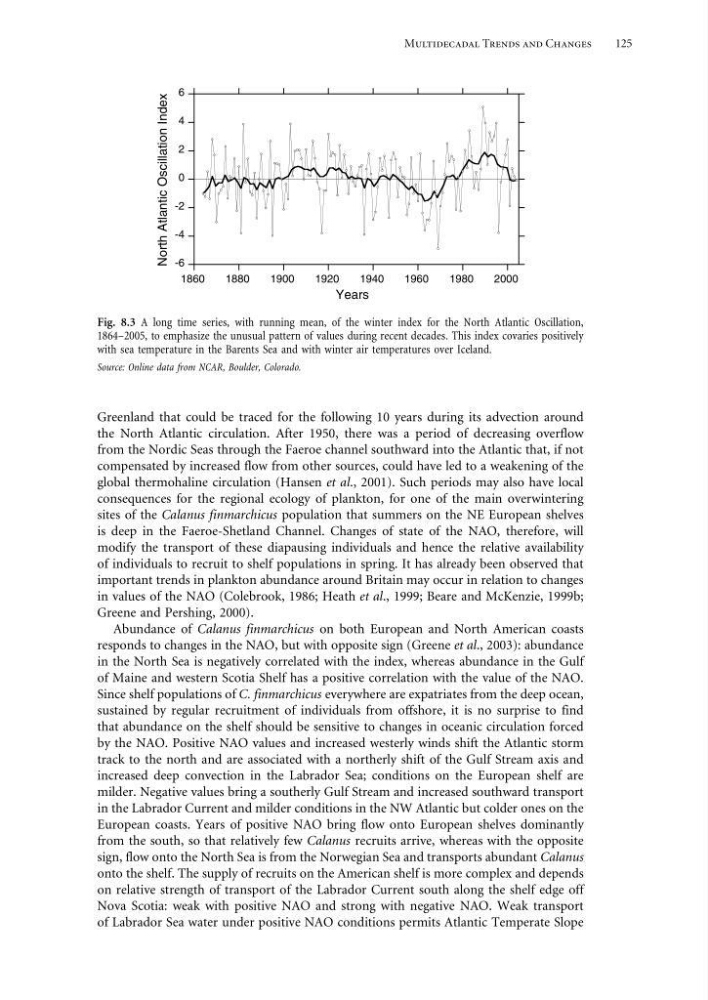
Fig. 8.3 A long time series, with running mean, of the winter index for the North Atlantic Oscillation,
1864–2005, to emphasize the unusual pattern of values during recent decades. This index covaries positively
with sea temperature in the Barents Sea and with winter air temperatures over Iceland.
Source: Online data from NCAR, Boulder, Colorado.
Greenland that could be traced for the following 10 years during its advection around
the North Atlantic circulation. After 1950, there was a period of decreasing overflow
from the Nordic Seas through the Faeroe channel southward into the Atlantic that, if not
compensated by increased flow from other sources, could have led to a weakening of the
global thermohaline circulation (Hansen et al., 2001). Such periods may also have local
consequences for the regional ecology of plankton, for one of the main overwintering
sites of the Calanus finmarchicus population that summers on the NE European shelves
is deep in the Faeroe-Shetland Channel. Changes of state of the NAO, therefore, will
modify the transport of these diapausing individuals and hence the relative availability
of individuals to recruit to shelf populations in spring. It has already been observed that
important trends in plankton abundance around Britain may occur in relation to changes
in values of the NAO (Colebrook, 1986; Heath et al., 1999; Beare and McKenzie, 1999b;
Greene and Pershing, 2000).
Abundance of Calanus finmarchicus on both European and North American coasts
responds to changes in the NAO, but with opposite sign (Greene et al., 2003): abundance
in the North Sea is negatively correlated with the index, whereas abundance in the Gulf
of Maine and western Scotia Shelf has a positive correlation with the value of the NAO.
Since shelf populations of C. finmarchicus everywhere are expatriates from the deep ocean,
sustained by regular recruitment of individuals from offshore, it is no surprise to find
that abundance on the shelf should be sensitive to changes in oceanic circulation forced
by the NAO. Positive NAO values and increased westerly winds shift the Atlantic storm
track to the north and are associated with a northerly shift of the Gulf Stream axis and
increased deep convection in the Labrador Sea; conditions on the European shelf are
milder. Negative values bring a southerly Gulf Stream and increased southward transport
in the Labrador Current and milder conditions in the NW Atlantic but colder ones on the
European coasts. Years of positive NAO bring flow onto European shelves dominantly
from the south, so that relatively few Calanus recruits arrive, whereas with the opposite
sign, flow onto the North Sea is from the Norwegian Sea and transports abundant Calanus
onto the shelf. The supply of recruits on the American shelf is more complex and depends
on relative strength of transport of the Labrador Current south along the shelf edge off
Nova Scotia: weak with positive NAO and strong with negative NAO. Weak transport
of Labrador Sea water under positive NAO conditions permits Atlantic Temperate Slope
125
-6
-4
-2
0
2
4
6
1860
1880
1900
1920
1940
1960
1980
2000
North Atlantic Oscillation Index
Years
Fig. 8.3 A long time series, with running mean, of the winter index for the North Atlantic Oscillation,
1864–2005, to emphasize the unusual pattern of values during recent decades. This index covaries positively
with sea temperature in the Barents Sea and with winter air temperatures over Iceland.
Source: Online data from NCAR, Boulder, Colorado.
Greenland that could be traced for the following 10 years during its advection around
the North Atlantic circulation. After 1950, there was a period of decreasing overflow
from the Nordic Seas through the Faeroe channel southward into the Atlantic that, if not
compensated by increased flow from other sources, could have led to a weakening of the
global thermohaline circulation (Hansen et al., 2001). Such periods may also have local
consequences for the regional ecology of plankton, for one of the main overwintering
sites of the Calanus finmarchicus population that summers on the NE European shelves
is deep in the Faeroe-Shetland Channel. Changes of state of the NAO, therefore, will
modify the transport of these diapausing individuals and hence the relative availability
of individuals to recruit to shelf populations in spring. It has already been observed that
important trends in plankton abundance around Britain may occur in relation to changes
in values of the NAO (Colebrook, 1986; Heath et al., 1999; Beare and McKenzie, 1999b;
Greene and Pershing, 2000).
Abundance of Calanus finmarchicus on both European and North American coasts
responds to changes in the NAO, but with opposite sign (Greene et al., 2003): abundance
in the North Sea is negatively correlated with the index, whereas abundance in the Gulf
of Maine and western Scotia Shelf has a positive correlation with the value of the NAO.
Since shelf populations of C. finmarchicus everywhere are expatriates from the deep ocean,
sustained by regular recruitment of individuals from offshore, it is no surprise to find
that abundance on the shelf should be sensitive to changes in oceanic circulation forced
by the NAO. Positive NAO values and increased westerly winds shift the Atlantic storm
track to the north and are associated with a northerly shift of the Gulf Stream axis and
increased deep convection in the Labrador Sea; conditions on the European shelf are
milder. Negative values bring a southerly Gulf Stream and increased southward transport
in the Labrador Current and milder conditions in the NW Atlantic but colder ones on the
European coasts. Years of positive NAO bring flow onto European shelves dominantly
from the south, so that relatively few Calanus recruits arrive, whereas with the opposite
sign, flow onto the North Sea is from the Norwegian Sea and transports abundant Calanus
onto the shelf. The supply of recruits on the American shelf is more complex and depends
on relative strength of transport of the Labrador Current south along the shelf edge off
Nova Scotia: weak with positive NAO and strong with negative NAO. Weak transport
of Labrador Sea water under positive NAO conditions permits Atlantic Temperate Slope