

Recurrent, ENSO-Scale Changes of State
121
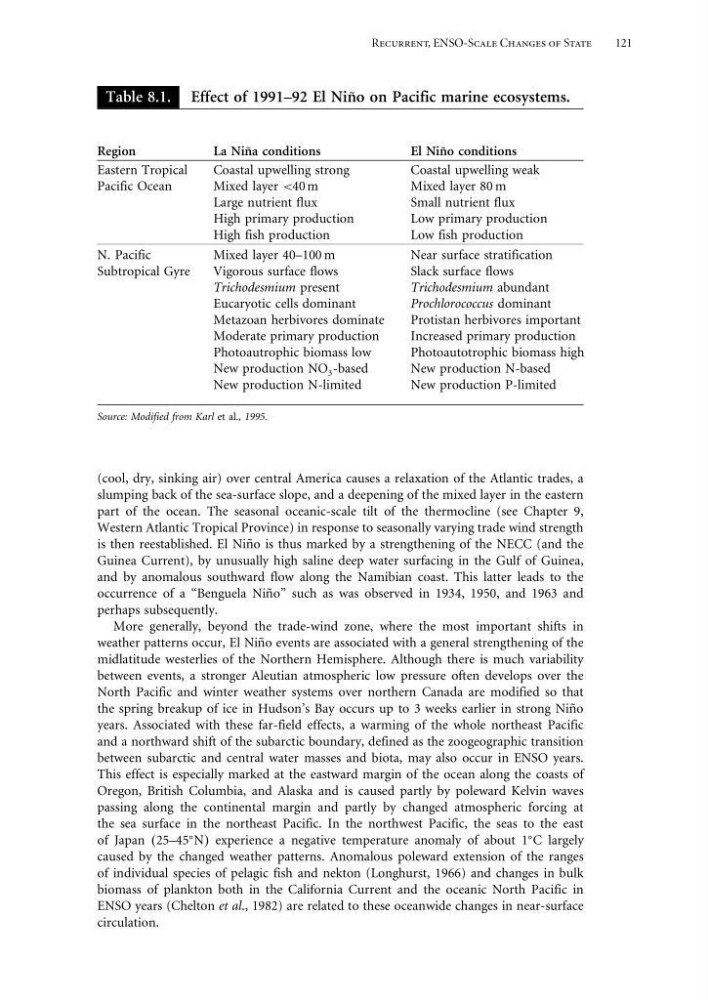
Table 8.1. Effect of 1991–92 El Niño on Pacific marine ecosystems.
Region
La Niña conditions
El Niño conditions
Eastern Tropical
Pacific Ocean
Coastal upwelling strong
Mixed layer <40 m
Large nutrient flux
High primary production
High fish production
Coastal upwelling weak
Mixed layer 80 m
Small nutrient flux
Low primary production
Low fish production
N. Pacific
Subtropical Gyre
Mixed layer 40–100 m
Vigorous surface flows
Trichodesmium present
Eucaryotic cells dominant
Metazoan herbivores dominate
Moderate primary production
Photoautrophic biomass low
New production NO 3 -based
New production N-limited
Near surface stratification
Slack surface flows
Trichodesmium abundant
Prochlorococcus dominant
Protistan herbivores important
Increased primary production
Photoautotrophic biomass high
New production N-based
New production P-limited
Source: Modified from Karl et al., 1995.
(cool, dry, sinking air) over central America causes a relaxation of the Atlantic trades, a
slumping back of the sea-surface slope, and a deepening of the mixed layer in the eastern
part of the ocean. The seasonal oceanic-scale tilt of the thermocline (see Chapter 9,
Western Atlantic Tropical Province) in response to seasonally varying trade wind strength
is then reestablished. El Niño is thus marked by a strengthening of the NECC (and the
Guinea Current), by unusually high saline deep water surfacing in the Gulf of Guinea,
and by anomalous southward flow along the Namibian coast. This latter leads to the
occurrence of a “Benguela Niño” such as was observed in 1934, 1950, and 1963 and
perhaps subsequently.
More generally, beyond the trade-wind zone, where the most important shifts in
weather patterns occur, El Niño events are associated with a general strengthening of the
midlatitude westerlies of the Northern Hemisphere. Although there is much variability
between events, a stronger Aleutian atmospheric low pressure often develops over the
North Pacific and winter weather systems over northern Canada are modified so that
the spring breakup of ice in Hudson’s Bay occurs up to 3 weeks earlier in strong Niño
years. Associated with these far-field effects, a warming of the whole northeast Pacific
and a northward shift of the subarctic boundary, defined as the zoogeographic transition
between subarctic and central water masses and biota, may also occur in ENSO years.
This effect is especially marked at the eastward margin of the ocean along the coasts of
Oregon, British Columbia, and Alaska and is caused partly by poleward Kelvin waves
passing along the continental margin and partly by changed atmospheric forcing at
the sea surface in the northeast Pacific. In the northwest Pacific, the seas to the east
of Japan 25–45
N experience a negative temperature anomaly of about 1
C largely
caused by the changed weather patterns. Anomalous poleward extension of the ranges
of individual species of pelagic fish and nekton (Longhurst, 1966) and changes in bulk
biomass of plankton both in the California Current and the oceanic North Pacific in
ENSO years (Chelton et al., 1982) are related to these oceanwide changes in near-surface
circulation.
121
Table 8.1. Effect of 1991–92 El Niño on Pacific marine ecosystems.
Region
La Niña conditions
El Niño conditions
Eastern Tropical
Pacific Ocean
Coastal upwelling strong
Mixed layer <40 m
Large nutrient flux
High primary production
High fish production
Coastal upwelling weak
Mixed layer 80 m
Small nutrient flux
Low primary production
Low fish production
N. Pacific
Subtropical Gyre
Mixed layer 40–100 m
Vigorous surface flows
Trichodesmium present
Eucaryotic cells dominant
Metazoan herbivores dominate
Moderate primary production
Photoautrophic biomass low
New production NO 3 -based
New production N-limited
Near surface stratification
Slack surface flows
Trichodesmium abundant
Prochlorococcus dominant
Protistan herbivores important
Increased primary production
Photoautotrophic biomass high
New production N-based
New production P-limited
Source: Modified from Karl et al., 1995.
(cool, dry, sinking air) over central America causes a relaxation of the Atlantic trades, a
slumping back of the sea-surface slope, and a deepening of the mixed layer in the eastern
part of the ocean. The seasonal oceanic-scale tilt of the thermocline (see Chapter 9,
Western Atlantic Tropical Province) in response to seasonally varying trade wind strength
is then reestablished. El Niño is thus marked by a strengthening of the NECC (and the
Guinea Current), by unusually high saline deep water surfacing in the Gulf of Guinea,
and by anomalous southward flow along the Namibian coast. This latter leads to the
occurrence of a “Benguela Niño” such as was observed in 1934, 1950, and 1963 and
perhaps subsequently.
More generally, beyond the trade-wind zone, where the most important shifts in
weather patterns occur, El Niño events are associated with a general strengthening of the
midlatitude westerlies of the Northern Hemisphere. Although there is much variability
between events, a stronger Aleutian atmospheric low pressure often develops over the
North Pacific and winter weather systems over northern Canada are modified so that
the spring breakup of ice in Hudson’s Bay occurs up to 3 weeks earlier in strong Niño
years. Associated with these far-field effects, a warming of the whole northeast Pacific
and a northward shift of the subarctic boundary, defined as the zoogeographic transition
between subarctic and central water masses and biota, may also occur in ENSO years.
This effect is especially marked at the eastward margin of the ocean along the coasts of
Oregon, British Columbia, and Alaska and is caused partly by poleward Kelvin waves
passing along the continental margin and partly by changed atmospheric forcing at
the sea surface in the northeast Pacific. In the northwest Pacific, the seas to the east
of Japan 25–45
N experience a negative temperature anomaly of about 1
C largely
caused by the changed weather patterns. Anomalous poleward extension of the ranges
of individual species of pelagic fish and nekton (Longhurst, 1966) and changes in bulk
biomass of plankton both in the California Current and the oceanic North Pacific in
ENSO years (Chelton et al., 1982) are related to these oceanwide changes in near-surface
circulation.