

39
grown alone in the deep pots when it was planted early and there was no difference
in the dry mass in the pots with different depths (Fig. 6.6 ). Dry mass of the grass,
Bouteloua curtipendula, was dependent on the pot depth but not the time of planting
or the presence of the woody plant. Results of the two-way ANOVA for aboveground, belowground, and total dry mass for Bouteloua curtipendula and the same
experimental factors (soil depth and planting combination) and their interaction
showed that soil depth was signifi cant, but planting combination and their interaction was not ( P < 0.0001, 0.3869, and 0.0830, respectively, with values for belowground and total dry mass being very similar).
In the fi eld, root excluders were used to examine potential belowground grass
interference with woody legume growth, specifi cally P. glandulosa (Van Auken and
Bush 1997 ). Root excluders were 10 cm diameter PVC pipes cut to lengths of 2, 20,
and 40 cm and pounded into the ground until only the surface edge was exposed.
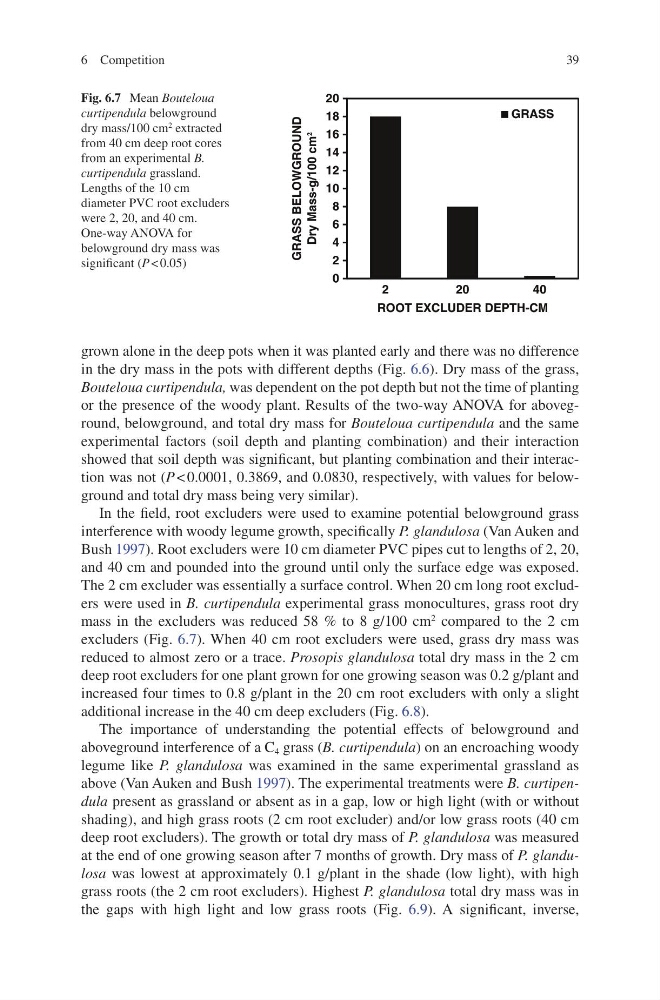
The 2 cm excluder was essentially a surface control. When 20 cm long root excluders were used in B. curtipendula experimental grass monocultures, grass root dry
mass in the excluders was reduced 58 % to 8 g/100 cm
2 compared to the 2 cm
excluders (Fig. 6.7 ). When 40 cm root excluders were used, grass dry mass was
reduced to almost zero or a trace. Prosopis glandulosa total dry mass in the 2 cm
deep root excluders for one plant grown for one growing season was 0.2 g/plant and
increased four times to 0.8 g/plant in the 20 cm root excluders with only a slight
additional increase in the 40 cm deep excluders (Fig. 6.8 ).
The importance of understanding the potential effects of belowground and
aboveground interference of a C 4 grass ( B. curtipendula ) on an encroaching woody
legume like P. glandulosa was examined in the same experimental grassland as
above (Van Auken and Bush 1997 ). The experimental treatments were B. curtipendula present as grassland or absent as in a gap, low or high light (with or without
shading), and high grass roots (2 cm root excluder) and/or low grass roots (40 cm
deep root excluders). The growth or total dry mass of P. glandulosa was measured
at the end of one growing season after 7 months of growth. Dry mass of P. glandulosa was lowest at approximately 0.1 g/plant in the shade (low light), with high
grass roots (the 2 cm root excluders). Highest P. glandulosa total dry mass was in
the gaps with high light and low grass roots (Fig. 6.9 ). A signifi cant, inverse,
0
2
4
6
8
10
12
14
16
18
20
2
2 0
4 0
GRASS BELOWGROUND
Dry Mass-g/100 cm²
ROOT EXCLUDER DEPTH-CM
GRASS
Fig. 6.7 Mean Bouteloua
curtipendula belowground
dry mass/100 cm
2 extracted
from 40 cm deep root cores
from an experimental B.
curtipendula grassland.
Lengths of the 10 cm
diameter PVC root excluders
were 2, 20, and 40 cm.
One-way ANOVA for
belowground dry mass was
signifi cant ( P < 0.05)
6 Competition
grown alone in the deep pots when it was planted early and there was no difference
in the dry mass in the pots with different depths (Fig. 6.6 ). Dry mass of the grass,
Bouteloua curtipendula, was dependent on the pot depth but not the time of planting
or the presence of the woody plant. Results of the two-way ANOVA for aboveground, belowground, and total dry mass for Bouteloua curtipendula and the same
experimental factors (soil depth and planting combination) and their interaction
showed that soil depth was signifi cant, but planting combination and their interaction was not ( P < 0.0001, 0.3869, and 0.0830, respectively, with values for belowground and total dry mass being very similar).
In the fi eld, root excluders were used to examine potential belowground grass
interference with woody legume growth, specifi cally P. glandulosa (Van Auken and
Bush 1997 ). Root excluders were 10 cm diameter PVC pipes cut to lengths of 2, 20,
and 40 cm and pounded into the ground until only the surface edge was exposed.
The 2 cm excluder was essentially a surface control. When 20 cm long root excluders were used in B. curtipendula experimental grass monocultures, grass root dry
mass in the excluders was reduced 58 % to 8 g/100 cm
2 compared to the 2 cm
excluders (Fig. 6.7 ). When 40 cm root excluders were used, grass dry mass was
reduced to almost zero or a trace. Prosopis glandulosa total dry mass in the 2 cm
deep root excluders for one plant grown for one growing season was 0.2 g/plant and
increased four times to 0.8 g/plant in the 20 cm root excluders with only a slight
additional increase in the 40 cm deep excluders (Fig. 6.8 ).
The importance of understanding the potential effects of belowground and
aboveground interference of a C 4 grass ( B. curtipendula ) on an encroaching woody
legume like P. glandulosa was examined in the same experimental grassland as
above (Van Auken and Bush 1997 ). The experimental treatments were B. curtipendula present as grassland or absent as in a gap, low or high light (with or without
shading), and high grass roots (2 cm root excluder) and/or low grass roots (40 cm
deep root excluders). The growth or total dry mass of P. glandulosa was measured
at the end of one growing season after 7 months of growth. Dry mass of P. glandulosa was lowest at approximately 0.1 g/plant in the shade (low light), with high
grass roots (the 2 cm root excluders). Highest P. glandulosa total dry mass was in
the gaps with high light and low grass roots (Fig. 6.9 ). A signifi cant, inverse,
0
2
4
6
8
10
12
14
16
18
20
2
2 0
4 0
GRASS BELOWGROUND
Dry Mass-g/100 cm²
ROOT EXCLUDER DEPTH-CM
GRASS
Fig. 6.7 Mean Bouteloua
curtipendula belowground
dry mass/100 cm
2 extracted
from 40 cm deep root cores
from an experimental B.
curtipendula grassland.
Lengths of the 10 cm
diameter PVC root excluders
were 2, 20, and 40 cm.
One-way ANOVA for
belowground dry mass was
signifi cant ( P < 0.05)
6 Competition